


• Skip to main content
  • Skip to secondary menu
  • Skip to primary sidebar
  • Skip to footer
Montreal AI Ethics Institute

Montreal AI Ethics Institute

Democratizing AI ethics literacy

  • Articles
    • Public Policy
    • Privacy & Security
    • Human Rights
      • Ethics
      • JEDI (Justice, Equity, Diversity, Inclusion
    • Climate
    • Design
      • Emerging Technology
    • Application & Adoption
      • Health
      • Education
      • Government
        • Military
        • Public Works
      • Labour
    • Arts & Culture
      • Film & TV
      • Music
      • Pop Culture
      • Digital Art
  • Columns
    • AI Policy Corner
    • Recess
    • Tech Futures
  • The AI Ethics Brief
  • AI Literacy
    • Research Summaries
    • AI Ethics Living Dictionary
    • Learning Community
  • The State of AI Ethics Report
    • Volume 7 (November 2025)
    • Volume 6 (February 2022)
    • Volume 5 (July 2021)
    • Volume 4 (April 2021)
    • Volume 3 (Jan 2021)
    • Volume 2 (Oct 2020)
    • Volume 1 (June 2020)
  • About
    • Our Contributions Policy
    • Our Open Access Policy
    • Contact
    • Donate

Compute Trends Across Three Eras of Machine Learning

May 28, 2023

šŸ”¬ Research Summary by Lennart Heim, a Research Scholar at the Centre for the Governance of AI and Research Fellow at Epoch.

[Original paper by Jaime Sevilla, Lennart Heim, Anson Ho, Tamay Besiroglu, Marius Hobbhahn, and Pablo Villalobos]

NOTE: This post was written based on work done in 2022.


Overview: Compute required for training notable Machine Learning systems has been doubling every six months — growing by a factor of 55 million over the last 12 years. This paper curates a dataset of 123 ML models and analyses their compute requirements. The authors find three distinct trends and explain them in three eras: Pre Deep Learning era, the Deep Learning era starting in 2012, and a new emerging Large-Scale trend in 2016.


Introduction

Computational resources (in short, compute) are a necessary resource for ML systems. Next to data and algorithmic advances, compute is a fundamental driver of advances in AI, as the performance of machine learning models tends to scale with compute. In this paper, the authors study the amount of compute required — measured in the number of floating point operations (FLOP) — for the final training run of milestone ML systems. They curate a dataset of 123 ML models over the last 50 years, analyze their training compute, and explain the trends in three eras.

Key Insights

Three Eras

The authors find that before the Deep Learning era, training compute approximately followed Moore’s law, doubling every 20 months. With the emergence of the Deep Learning era between 2010 and 2012, the doubling time speeds up to 5 to 6 months.

More recently, they found a new separate trend of large-scale models, which emerged in 2015 and 2016 with massive training runs sponsored by large private corporations. This trend is distinct in two to three orders of magnitude (OOMs) more compute required than systems following the previous Deep Learning era trend. They find a doubling time of 10 months for these systems.
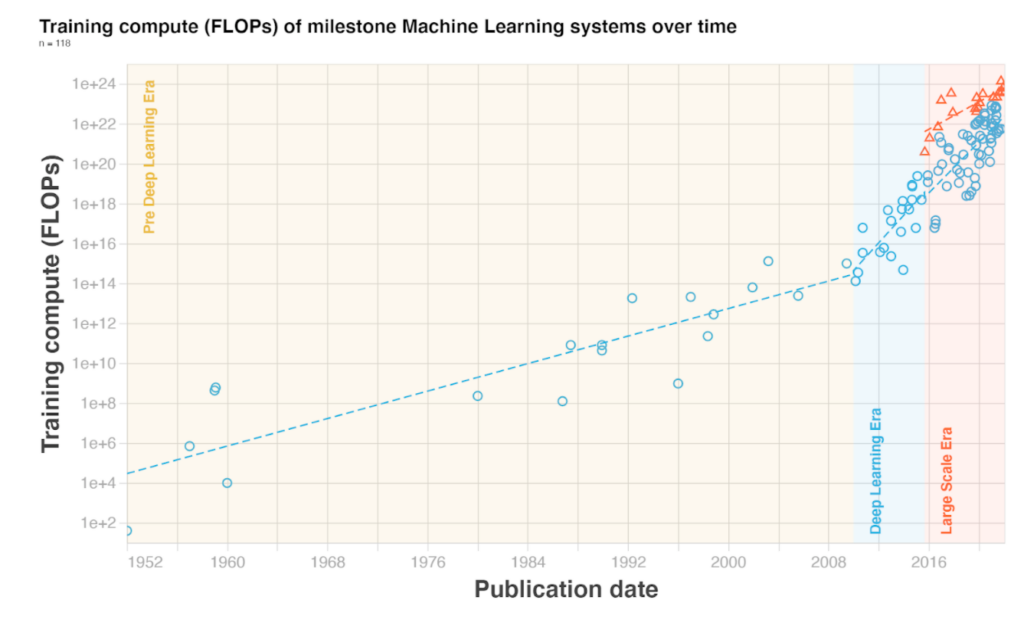
Figure 1: Trends in n=118 milestone Machine Learning systems between 1950 and 2022 distinguished in three eras. Note the slope change circa 2010, matching the advent of Deep Learning and the emergence of a new large-scale trend in late 2015.

Slower than previously reported

OpenAI’s analysis from 2018 finds a 3.4-month doubling from 2012 to 2018. Their analysis suggests a 5.7-month doubling time from 2012 to 2022.

The paper’s analysis differs in three points: (I) the number of samples, (II) the extended period, and (III) the identification of a distinct large-scale trend. Of these, either the period or the separation of the large-scale models is enough to explain the difference between the results. However, a doubling time of 6 months is still enormously fast and probably unsustainable in the future, with training these systems costing three digits million. 
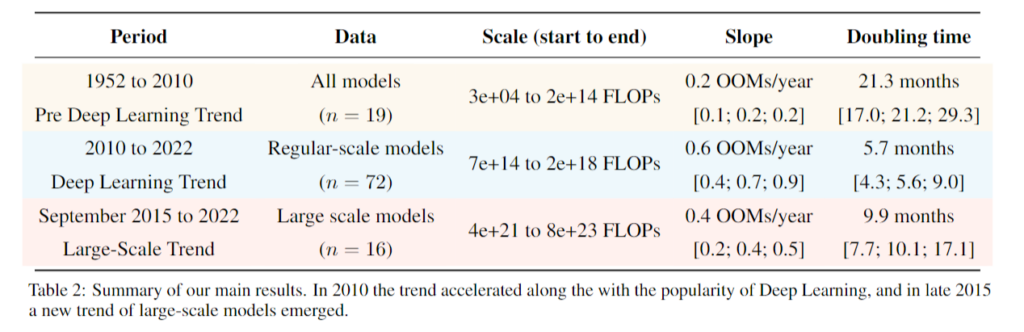
Table 1. Doubling time of training compute across three eras of Machine Learning.  The notation [low, median, high] denotes a confidence interval’s quantiles of 0.025, 0.5, and 0.975.

Public dataset and visualization

The dataset stemming from this paper is public and is continuously updated. You can use it for your analysis. The authors are also maintaining an interactive visualization which you can explore here.

Between the lines

Growth in training compute is unprecedented and largely enabled by increased spending on compute. In contrast, the performance of the best-performing high-performance computer has only grown by a factor of ā‰ˆ245x in the same period (compared to the 50M growth in training compute). Consequently, participating at the cutting edge of ML research has become more costly. Cutting-edge research in ML has become synonymous with access to large compute budgets or computing clusters and the expertise to leverage them. This is highlighted by the fact that since 2015 all compute training record-setting models stemming from the industry. The overall share of academia has significantly declined over time.
In response to this compute divide, nations are exploring plans to support academic and governmental researchers by providing them with more compute. The US’s National AI Research Resource (NAIRR) is the most prominent example.

Want quick summaries of the latest research & reporting in AI ethics delivered to your inbox? Subscribe to the AI Ethics Brief. We publish bi-weekly.

Primary Sidebar

šŸ” SEARCH

Spotlight

A network diagram with lots of little emojis, organised in clusters.

Tech Futures: AI For and Against Knowledge

A brightly coloured illustration which can be viewed in any direction. It has many elements to it working together: men in suits around a table, someone in a data centre, big hands controlling the scenes and holding a phone, people in a production line. Motifs such as network diagrams and melting emojis are placed throughout the busy vignettes.

Tech Futures: The Fossil Fuels Playbook for Big Tech: Part II

A rock embedded with intricate circuit board patterns, held delicately by pale hands drawn in a ghostly style. The contrast between the rough, metallic mineral and the sleek, artificial circuit board illustrates the relationship between raw natural resources and modern technological development. The hands evoke human involvement in the extraction and manufacturing processes.

Tech Futures: The Fossil Fuels Playbook for Big Tech: Part I

Close-up of a cat sleeping on a computer keyboard

Tech Futures: The threat of AI-generated code to the world’s digital infrastructure

The undying sun hangs in the sky, as people gather around signal towers, working through their digital devices.

Dreams and Realities in Modi’s AI Impact Summit

related posts

  • Slow AI and The Culture of Speed

    Slow AI and The Culture of Speed

  • ā€œA Proposal for Identifying and Managing Bias in Artificial Intelligenceā€. A draft from the NIST

    ā€œA Proposal for Identifying and Managing Bias in Artificial Intelligenceā€. A draft from the NIST

  • Code Work: Thinking with the System in Mexico

    Code Work: Thinking with the System in Mexico

  • The Canada Protocol: AI checklist for Mental Health & Suicide Prevention

    The Canada Protocol: AI checklist for Mental Health & Suicide Prevention

  • It’s COMPASlicated: The Messy Relationship between RAI Datasets and Algorithmic Fairness Benchmarks

    It’s COMPASlicated: The Messy Relationship between RAI Datasets and Algorithmic Fairness Benchmarks

  • Research summary: Social Biases in NLP Models as Barriers for Persons with Disabilities

    Research summary: Social Biases in NLP Models as Barriers for Persons with Disabilities

  • Eticas Foundation external audits VioGĆ©n: Spain’s algorithm designed to protect victims of gender vi...

    Eticas Foundation external audits VioGĆ©n: Spain’s algorithm designed to protect victims of gender vi...

  • Positive AI Economic Futures: Insight Report

    Positive AI Economic Futures: Insight Report

  • Can LLMs Enhance the Conversational AI Experience?

    Can LLMs Enhance the Conversational AI Experience?

  • Aging with AI: Another Source of Bias?

    Aging with AI: Another Source of Bias?

Partners

  • Ā 
    U.S. Artificial Intelligence Safety Institute Consortium (AISIC) at NIST

  • Partnership on AI

  • The LF AI & Data Foundation

  • The AI Alliance

Footer


Articles

Columns

AI Literacy

The State of AI Ethics Report


About Us


Founded in 2018, the Montreal AI Ethics Institute (MAIEI) is an international non-profit organization equipping citizens concerned about artificial intelligence and its impact on society to take action.

Contact

Donate


  • Ā© 2025 MONTREAL AI ETHICS INSTITUTE.
  • This work is licensed under a Creative Commons Attribution 4.0 International License.
  • Learn more about our open access policy here.
  • Creative Commons License

    Save hours of work and stay on top of Responsible AI research and reporting with our bi-weekly email newsletter.