

✍️ By Sarah Ruth and Marion Meyers
Sarah is a researcher committed to building critical AI literacies and worked as a copywriter on the Resist List.

Marion is an independent researcher focused on AI and degrowth, and worked as a project manager on the Resist List.
📌 Editor’s Note: This article is part of our Tech Futures series, a collaboration between the Montreal AI Ethics Institute (MAIEI) and the Responsible Artificial Intelligence Network (RAIN). The series challenges mainstream AI narratives, proposing that rigorous research and science are better sources of information about AI than industry leaders. This ninth instalment of Tech Futures explores the growing movement of individuals and collectives working to counter the dominant narratives of AI’s inevitability and introduces the AI Resist List, a newly launched resource that details such efforts happening around the globe.
The last edition of the Tech Futures series explored the AI inevitability narrative, its roots in eugenics ideologies, the ways it is used to justify extractive practices that exacerbate the climate crisis, and its parallels with science fiction. And yet, amid negative news cycles, narratives of AI inevitability remain pervasive.
Distracting lawsuits, claims about capability advancements, and rumours of OpenAI’s IPO are often wrapped in language about AI’s inevitability. Ultimately, they tend to instil fear in the public and quiet questions about why many AI systems are being built in the first place.
But it’s not only the media and AI industry that further narratives of inevitability. Governments are demanding a plan to deal with AGI and cementing AI know-how as a crucial skill and defining feature in the future of work, when they could instead be questioning the industry’s development at large or, at the very least, developing meaningful governance, limitations, or policies.
Some have called the narrative of inevitability a key component and mechanism for the increasing rise of technofascism. Explained by the tech ethics scholar Mark Coeckelbergh as “the fusion of technological pervasiveness with fascist tendencies and conditions,” technofascism explains how technologies increase capitalist control and privilege authoritarian politics.
If technofascism is intended to suppress political speech and silence resistance to the state or capitalism, as suggested by Joan Donavan, then it is all the more important to push back and build solidarity amongst the people and communities working to reshape and reimagine a future of meaningful beneficence.
Just this week, Karen Hao, the DAIR Institute, We and AI, and the Refugee Law Lab at York University launched a project that encapsulates and highlights just how wide this global movement of resistance to AI already is.
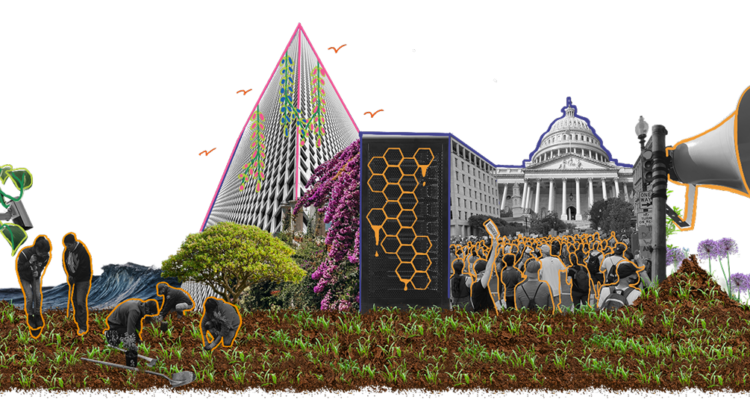
The AI Resist List is a curated journalistic resource that showcases examples of people, communities, and organisations combating the scale-at-all-costs approach to AI development happening around the world. The project was built on the collaborators’ shared belief that the future of AI is a shared decision, one that should be led by community needs rather than the ideologies and financial goals of a few tech companies.
At a time when more and more people are concerned about AI and its effects on their everyday lives, the project is timely in its aim to counter the rise of technofascism and to provide inspiration and hope for a better alternative. The AI Resist List is designed to appeal to a variety of audiences, from those who are deep in the trenches, raising awareness and fighting against AI inevitability narratives, to those who have become disillusioned about their limited role in technology. It is also for those who simply aren’t sure why talk of AI sometimes feels eerie, cringe, or a little off, or who are simply feeling overwhelmed by the endless string of absurd claims about AI from Big Tech executives, politicians, journalists, and so on. The AI Resist List is here to help diverse audiences realise that they are not alone in their uncertainties and that there are options to counter AI hype.
The AI Resist List is rooted in We and AI’s Resisting, Refusing, Reclaiming, Reimagining framework for challenging AI inevitability as well as Hao’s depiction of the current shape of the AI industry as an empire. It specifically took inspiration from Choose Democracy’s Resist List against authoritarianism to define a set of “pillars of support” that uphold and perpetuate the empire, namely:
- Narratives
- Funding
- Data
- Resource extraction
- Data centers
- Labour
- Adoption
- Surveillance
- Policy
Some projects featured on the list are rejecting Big Tech, like the South Island School in Hong Kong, where students and teachers are ridding the tech giants from their classrooms and are instead trialing alternative technologies and platforms like Pixelfed, an open-source alternative to Instagram. Others, such as O Panóptico in Brazil, are monitoring how surveillance technologies like facial recognition are used in public security systems.
The AI Resist List contains a section dedicated to showcasing the ways in which communities, organisations, and individuals are already reimagining and reclaiming AI to build alternative futures. It includes initiatives such as Te Hiku Media’s Te Reo Māori speech-recognition tool, built on the basis of community consent and interest, and the permacomputing movement, which seeks to reimagine the extractive relationship between computing, people, and the planet.
What the database shows is that there are many ways to resist the AI empires and Big Tech. While the AI Resist List is a journalistic and research attempt to capture current efforts, We and AI’s notinevitable.ai will be an associated forum for writing, research and discourse related to the theory, practice and stories that accompany it.
If you are working on an initiative that argues for a future that is collectively decided, against inevitability or technofascism, you are encouraged to contribute to the growing repository.
The future of AI is in our hands, but we cannot idly expect it to follow the interests of the many. The AI Resist List and notinevitable.ai remind us that we can change the narratives and practices surrounding emerging technologies, and that we are not alone in wanting better approaches to AI.
You can stay up to date or connect with those building alternative futures via the AI Resist List contact form.
Image credit: Image created by Yemariam Mamo and Pauline Wee for the AI Resist List