

• Skip to main content
  • Skip to secondary menu
  • Skip to primary sidebar
  • Skip to footer
Montreal AI Ethics Institute

Montreal AI Ethics Institute

Democratizing AI ethics literacy

  • Articles
    • Public Policy
    • Privacy & Security
    • Human Rights
      • Ethics
      • JEDI (Justice, Equity, Diversity, Inclusion
    • Climate
    • Design
      • Emerging Technology
    • Application & Adoption
      • Health
      • Education
      • Government
        • Military
        • Public Works
      • Labour
    • Arts & Culture
      • Film & TV
      • Music
      • Pop Culture
      • Digital Art
  • Columns
    • AI Policy Corner
    • Recess
    • Tech Futures
  • The AI Ethics Brief
  • AI Literacy
    • Research Summaries
    • AI Ethics Living Dictionary
    • Learning Community
  • The State of AI Ethics Report
    • Volume 7 (November 2025)
    • Volume 6 (February 2022)
    • Volume 5 (July 2021)
    • Volume 4 (April 2021)
    • Volume 3 (Jan 2021)
    • Volume 2 (Oct 2020)
    • Volume 1 (June 2020)
  • About
    • Our Contributions Policy
    • Our Open Access Policy
    • Contact
    • Donate

Tech Futures: The Fossil Fuels Playbook for Big Tech: Part I

March 16, 2026

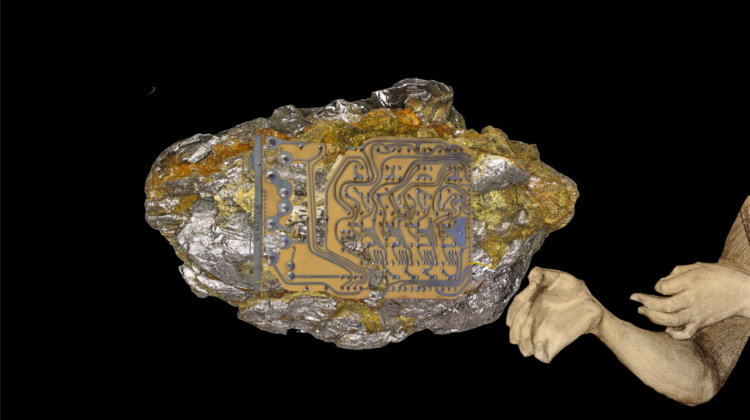
A rock embedded with intricate circuit board patterns, held delicately by pale hands drawn in a ghostly style. The contrast between the rough, metallic mineral and the sleek, artificial circuit board illustrates the relationship between raw natural resources and modern technological development. The hands evoke human involvement in the extraction and manufacturing processes.

✍️ By Ismael Kherroubi Garcia.

Ismael is Founder & Co-lead of the Responsible Artificial Intelligence Network (RAIN), and Founder & CEO of Kairoi.


📌 Editor’s Note: This article is part of our Tech Futures series, a collaboration between the Montreal AI Ethics Institute (MAIEI) and the Responsible Artificial Intelligence Network (RAIN). In this special instalment of Tech Futures by RAIN, we consider two ways in which the Big Tech industry draws on the playbook of the fossil fuels industry.


Oil was the driving force of economic growth in the 20th century. Now, it’s AI. That’s the story motivating many large-scale investments into AI innovation, research and infrastructure, from the US to the Persian Gulf to Asia and beyond. AI is seen as a vehicle for economic growth. But is this the only sense in which AI and oil are similar, or is there more beneath the surface? What else does the analogy point to? In this two-part series, we present four ways in which Big Tech reflects the practices of the fossil fuels industry: by shaping research, owning fiction, mining resources, and infiltrating policy.

Shaping Research

For decades, the fossil fuels industry has produced research that undermines the link between fossil fuels and climate change. The role of carbon emissions in rising global temperatures was hypothesized in 1896 by Swedish scientist Svante Arrhenius, whose work was crucial for climate science to take off in the 1950s. By then, industry firms were leading in fossil fuels research through the Smoke and Fumes Committee, established in the 1940s and operating within the American Petroleum Institute (API) for the following two decades. Among their members were Esso (now ExxonMobil), Shell, and companies now part of Chevron. This makes sense; understanding your own product is good business. But their research was not open or impactful in the way scientific research is. The industry learned of the environmental effects of carbon emissions, but kept that information to themselves to the detriment of climate scientists, policy makers, and the wellbeing of our planet.

Big Tech has been doing something similar. Leading AI firms have funded researchers at universities for some time, thereby shaping research questions and even how findings are framed. Things become clearer within Big Tech firms like Google, where a “sensitive topics” review process was developed in 2020. On the back of the process, internal correspondence from a senior Google manager stated the need to “take great care to strike a positive tone” in publications, and Dr. Timnit Gebru was fired for defending her work On the dangers of stochastic parrots.

Similar to the Smoke and Fumes Committee, Big Tech has also collaborated in shaping AI research. In 2016, Partnership on AI (PAI) was established by Google, Microsoft, Facebook, IBM, and Amazon, among others, including academic and non-profit organizations. PAI’s stated goal was “to study and formulate best practices on AI technologies, [and study] AI and its influences on people and society.” However, a number of the academic and non-profit members eventually concluded that their role was to legitimize the effort, rather than be heard. Ultimately, Big Tech-funded science steers academia towards the promotion of their own, profit-driven interests; not the knowledge-production activities that society needs and science delivers.

Owning Fiction

In 1915, Ford Motor Company started its own film production unit. Shell, BP, Total and other fossil fuel companies would follow Ford’s lead throughout the century, establishing a deep but complex relationship with Hollywood. The goal was to produce films depicting oil prospecting as “a high-stakes game with massive rewards, whether for the nation, the stockholder, the potential employee, or just the average citizen who would benefit from a full tank, a warm bath, and a healthy economy.” By working with some of the best filmmakers and actors, the stories went on to win major awards.

The fossil fuels industry also produced films demonstrating their corporate responsibility. Shell and BP even became big players in the environmentalist cinematic movement of the 1960s and 1970s, with films such as Clean Water and The Shadow of Progress. Fast-forward to today, and we see these efforts as exemplars of “green washing,” providing misleading information to present oneself as environmentally friendly. Although they continue—most clearly, in advertising—we now see through the charming façades, as denounced by the Union of Concerned Scientists and so many others.

If Google wants to “strike a positive tone” in their scientific work, what must they think about AI being depicted as killer robots in so much fiction? Through 100 Zeros—a partnership with Range Media Partners—and with XPrize, Google has launched a $3.5M competition to promote “optimistic science fiction storytelling.” The 100 Zeros project was first spotted in 2024 and resulted in its first short in 2025, Sweetwater, which appears to present “a softer image of AI.”

Google is not alone in its purchase of silver-screen time. In 2022, Amazon purchased Metro-Goldwyn-Mayer, which is behind many Hollywood classics. In February 2026, Amazon MGM announced plans to adopt AI for cost-cutting purposes. Meanwhile, Apple’s co-founder Steve Jobs also funded Pixar in 1986; the movie Wall-E was seen to make nods to Apple products in 2008, and the Apple TV streaming service as we know it was launched in 2019.

Big Tech is trying to take over how we think about AI.

Image credit: Hanna Barakat  & Archival Images of AI + AIxDESIGN / Better Images of AI / CC BY 4.0

Want quick summaries of the latest research & reporting in AI ethics delivered to your inbox? Subscribe to the AI Ethics Brief. We publish bi-weekly.

Primary Sidebar

🔍 SEARCH

Spotlight

A network diagram with lots of little emojis, organised in clusters.

Tech Futures: AI For and Against Knowledge

A brightly coloured illustration which can be viewed in any direction. It has many elements to it working together: men in suits around a table, someone in a data centre, big hands controlling the scenes and holding a phone, people in a production line. Motifs such as network diagrams and melting emojis are placed throughout the busy vignettes.

Tech Futures: The Fossil Fuels Playbook for Big Tech: Part II

A rock embedded with intricate circuit board patterns, held delicately by pale hands drawn in a ghostly style. The contrast between the rough, metallic mineral and the sleek, artificial circuit board illustrates the relationship between raw natural resources and modern technological development. The hands evoke human involvement in the extraction and manufacturing processes.

Tech Futures: The Fossil Fuels Playbook for Big Tech: Part I

Close-up of a cat sleeping on a computer keyboard

Tech Futures: The threat of AI-generated code to the world’s digital infrastructure

The undying sun hangs in the sky, as people gather around signal towers, working through their digital devices.

Dreams and Realities in Modi’s AI Impact Summit

related posts

  • Social Context of LLMs - the BigScience Approach, Part 1: Overview of the Governance, Ethics, and L...

    Social Context of LLMs - the BigScience Approach, Part 1: Overview of the Governance, Ethics, and L...

  • Social Context of LLMs - the BigScience Approach, Part 2: Project Ethical and Legal Grounding

    Social Context of LLMs - the BigScience Approach, Part 2: Project Ethical and Legal Grounding

  • Who's watching? What you need to know about personal data security

    Who's watching? What you need to know about personal data security

  • Engaging the Public in AI's Journey: Lessons from the UK AI Safety Summit on Standards, Policy, and ...

    Engaging the Public in AI's Journey: Lessons from the UK AI Safety Summit on Standards, Policy, and ...

  • AI Policy Corner: AI Governance in East Asia: Comparing the AI Acts of South Korea and Japan

    AI Policy Corner: AI Governance in East Asia: Comparing the AI Acts of South Korea and Japan

  • AI Policy Corner: U.S. Executive Order on Advancing AI Education for American Youth

    AI Policy Corner: U.S. Executive Order on Advancing AI Education for American Youth

  • This image shows a large white, traditional, old building. The top half of the building represents the humanities (which is symbolised by the embedded text from classic literature which is faintly shown ontop the building). The bottom section of the building is embossed with mathematical formulas to represent the sciences. The middle layer of the image is heavily pixelated. On the steps at the front of the building there is a group of scholars, wearing formal suits and tie attire, who are standing around at the enternace talking and some of them are sitting on the steps. There are two stone, statute-like hands that are stretching the building apart from the left side. In the forefront of the image, there are 8 students - which can only be seen from the back. Their graduation gowns have bright blue hoods and they all look as though they are walking towards the old building which is in the background at a distance. There are a mix of students in the foreground.

    Tech Futures: Co-opting Research and Education

  • ISED Launches AI Risk Management Guide Based on Voluntary Code

    ISED Launches AI Risk Management Guide Based on Voluntary Code

  • AI Policy Corner: Discussing the White House’s 2025 AI Action Plan

    AI Policy Corner: Discussing the White House’s 2025 AI Action Plan

  • A person sits in an armchair and writes in a notebook, with speech bubbles showing indefinite strokes and then a lightbulb. Nearby, a table with a laptop showing an LLM chatbot interface and a cup.

    AI Policy Corner: Layered Governance in AI Labs: Defining Boundaries Across the Policy Stack

Partners

  •  
    U.S. Artificial Intelligence Safety Institute Consortium (AISIC) at NIST

  • Partnership on AI

  • The LF AI & Data Foundation

  • The AI Alliance

Footer


Articles

Columns

AI Literacy

The State of AI Ethics Report


About Us


Founded in 2018, the Montreal AI Ethics Institute (MAIEI) is an international non-profit organization equipping citizens concerned about artificial intelligence and its impact on society to take action.

Contact

Donate


  • © 2025 MONTREAL AI ETHICS INSTITUTE.
  • This work is licensed under a Creative Commons Attribution 4.0 International License.
  • Learn more about our open access policy here.
  • Creative Commons License

    Save hours of work and stay on top of Responsible AI research and reporting with our bi-weekly email newsletter.