


✍️ Column by Connor Wright, our Director of Partnerships.
Photo Credit: Jackie Hutchinson on Unsplash
Overview: Our Director of Partnerships, Connor Wright, was invited to speak at the MISSION Hubs Forum2026 in Montreal on the 11th of May, a key gathering for creative agencies across the world. Tasked with “Demystifying the AI-influenced reality,” and in line with MAIEI’s mission to democratize AI ethics literacy, Connor gave both technical and social explanations about the nature of AI while offering current examples of good and bad practices when implementing AI into enterprise workflows. His main argument emphasised how embedding AI into business operations without adequate governance and risk mitigation strategies can subject businesses to Goodhart’s Law, leading to costly decisions both financially and legally.
On the 12th of May in sunny Montreal, leaders of creative agencies were brought together to share, learn, and relate to one another at MISSION Hubs Forum26 co-hosted with the Humanise Collective. In particular, the proliferation of AI has raised important questions around the meaning of creative work (such as storytelling and marketing), alongside decisions being made surrounding the risk implementing AI into your creative business brings. To help tackle these issues, MAIEI was invited to give a keynote talk titled “Demystifying the AI-influenced reality.”
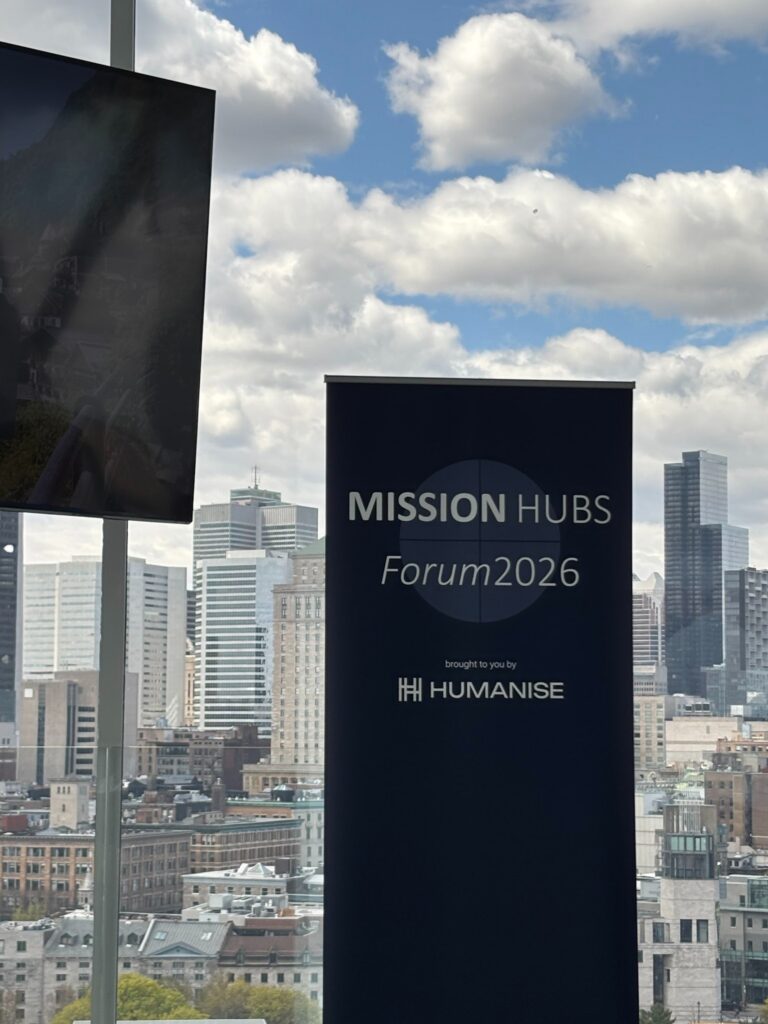
The event banner with a view of Montreal in the background
Being Realistic About Your AI Expectations
In Brief #173, we spoke about accepting technological determinism as inevitable (the thought that the world is marching towards a set amount of futures all centred around technology). The MISSION Hubs Forum26 captured the questions and fears surrounding the need to implement AI at scale in creative agencies, but also the confusion surrounding how best to integrate AI in a responsible way. My talk aimed to ground AI (specifically, LLMs and machine learning algorithms) in its current reality: materially demanding and heavily socially embedded.

The Forum venue, the Montreal Tower
Forum26 brought together a further two AI practitioners in Mitch Joel and Igor Alvarez, who also aligned with MAIEI’s emphasis on taking a holistic and responsible approach to AI implementation in creative agencies:
- Implementing AI solely for cost-cutting can deprioritise your customers
MAIEI showcased the example of Klarna firing 700 support staff in favour of AI agents, only to hire them back in a gig-work capacity because of customer frustration. As a fintech company, implementing AI agents failed to recognise the importance of human-human customer service as a fundamental cornerstone of their industry. Rather than focusing on the potential efficiencies gained from implementing AI, creative agencies ought to consider what their integration says about their company.
In particular, Aerie, an American Eagle fashion subsidiary, released their “Aerie Real Pledge” in a campaign with Pamela Anderson to emphasise the importance of keeping it real and avoiding touching up models’ photographs and using AI models. Their brand has always been about making their customers feel comfortable how they are, with this understanding informing their rally against AI use in their industry. AI implementation, no matter the industry, is not uniquely dedicated to cost-cutting; it requires thought around company ethos and branding, which is the next part of MAIEI’s approach.
- Being aggressive about AI use creates a company culture of fear and anxiety
“Tokenmaxxing” is a current trend within enterprise, encapsulating the attitude that the more employees use AI (the more tokens produced), the better. This became Duolingo’s initial approach to being an AI-first company, leading to employees becoming anxious and fearful of the need to use AI or lose their jobs, even if AI did not improve their workflow. Ultimately, Duolingo backtracked and opted for “outcomemaxxing” instead – thinking strategically about where AI can make a difference to employees’ work and allow them to carry out their tasks more easily.
MAIEI pointed out how “tokenmaxxing” is a classic case of Goodhart’s Law: when a measure becomes an aim, it ceases to be a measure. Instead, creative agencies ought to consider how AI technologies can aid current workflows and, better yet, help create new ones to venture into new business markets. Using AI for AI’s sake is a surface-level engagement with AI systems, which shows a lack of understanding as opposed to cutting-edge thinking about AI-enterprise integration. To prevent this kind of situation, it’s best to ask “why?” and not just “how?”.
- Asking “why?” helps to avoid irreversible and costly business decisions
Posing the question of “why?” inspires a closer look at how AI can, or cannot, improve different parts of a creative agency’s business. It allows the business to exercise autonomy over its workflow while also prompting it to consider the responsible AI governance frameworks required to deploy AI within its organisation successfully. By only asking “how?”, these considerations fall to the side and come back to bite later on, as happened with Klarna.

Our Director of Partnerships, Connor Wright, with Will Gadd, a professional ice-climber and guest speaker
Overall takeaway: do not succumb to Goodhart’s Law when implementing AI
MAIEI’s talk acknowledged how AI in creative agencies can be useful: it can help with ideation and research for marketing campaigns, facilitate easier access to data across a creative agency’s business, help with routine document review, and automate low-risk tasks such as taking meeting notes. To fully embrace AI integration, avoid Goodhart’s Law and harness AI’s benefits, a holistic and responsible governance approach to AI is required. Not doing so invites risk and, ultimately, leads to costly backtracking and employee discontent.