

✍️ By Ismael Kherroubi Garcia.
Ismael is Founder & Co-lead of the Responsible Artificial Intelligence Network (RAIN), and Founder & CEO of Kairoi.
📌 Editor’s Note: This article is part of our Tech Futures series, a collaboration between the Montreal AI Ethics Institute (MAIEI) and the Responsible Artificial Intelligence Network (RAIN). In this special instalment of Tech Futures by RAIN, we describe two ways in which the Big Tech industry draws on the playbook of the fossil fuels industry.
In the previous instalment of Tech Futures, we explored Big Tech’s capture of AI research and its fictional narratives. These are two practices that the fossil fuels industry has been refining for decades. In this follow-up instalment, we continue asking to what degree AI is “the new oil.” We delve into two more similarities concerning AI’s materiality, and Big Tech’s infiltration of policy-making spaces.
Mining for Metaphors
Prospecting, pipelines, drilling rigs, smog… Fossil fuels are a dirty business, and the industry has long sought ways to create a softer, kinder image. In “natural gas,” the industry has found an opportunity. After all, it’s “natural,” and what is “natural” if not a good thing, like a granola bar with all-natural ingredients?
Natural gas is mostly made up of methane, and methane’s global warming potential is 23 times that of carbon dioxide on a 100-year timescale. But “natural gas” sounds so much better than “coal” or “oil,” regardless of its composition. One survey of 4,600 Americans showed precisely this: “77% had a favorable view of natural gas, far higher than when asked about their views on methane.” Another rising metaphor is that of a bridge. Natural gas is often touted as a “bridge fuel” during a transitional phase from coal to a low-carbon future. The term “bridge fuel” is criticized by scholars for its ambiguity.
What could possibly make Big Tech look in-tune with nature? After all, “AI” emphasizes the artificiality of their products. There is a simple sense in which Big Tech and the fossil fuels industry are similar: both rely on mining, on the extraction of materials from the earth. In the case of Big Tech, companies mine for critical minerals that serve the manufacturing of semiconductors, which are fundamental to modern electronics and AI infrastructure. Although this aspect of AI is much less obvious than it is for fossil fuels, Big Tech has found a nature-friendly metaphor for their infrastructure-heavy work: the cloud.
“The cloud” began as a metaphor for the networks operated by telecommunications companies in the 1980s. “Cloud computing” arose as a term in the 1990s and has gained traction since, but it shares in the ambiguity of “natural gas.” As the US’s National Institute of Standards and Technologies acknowledges in their guidelines on the matter, “cloud computing can and does mean different things to different people.” Importantly, “the cloud” downplays the dirty and messy nature of mining, and the immensity of data centres.
Infiltrating Policy
Between 2021 and 2024, over 5,000 fossil fuel lobbyists, representing the companies behind nearly 60% of global oil and gas production, attended UN climate summits. Fossil fuel lobbyists have also been found to eclipse delegations from most climate-vulnerable nations. The people most impacted by the climate crisis brought on by the industry face a much harder time reaching policy-makers than industry leaders themselves. We already mentioned the industry-led partnership of the 20th-century Smoke and Fumes Committee shaped research agendas. They also have a history of delaying key policies, and funding economists whose reports have even influenced the withdrawal of the US from the Paris Agreement – twice.
Today’s Big Tech players have also made significant inroads into policy-making spaces. Consider former US Vice President Harris’s meeting with Big Tech CEOs in 2023, during which then-President Biden said: “I hope you can educate us as to what you think is most needed to protect society.” Less than two years later, a similar group of Big Tech leaders would stand behind incoming President Trump during his inauguration. On the other side of the Atlantic, Big Tech’s budget for lobbying for deregulation in the EU grew by 50% over four years.
The policy sphere seems to hand quite a lot of power to Big Tech. Professor Ferrari has argued that tech is deemed a solution by many because of its alignment with the interests and logics of neoliberalism. Ultimately, Big Tech actors are becoming legitimized in policy-making spheres. The underlying narrative is that, if Big Tech is building AI, they are surely the experts on how it works and its impacts. However, this exhibits a purely technical notion of AI, as if it didn’t operate in a society and had social consequences; as if AI weren’t sociotechnical in nature.
Concluding
Over two special editions of the Tech Futures series, we have questioned how AI might effectively be the new oil. Indeed, we have outlined four ways in which Big Tech is deploying the same playbook the fossil fuels industry has followed for decades; shaping research, owning fiction, mining for metaphors and infiltrating policy.
Where do we go from here? Well, we can learn from the climate activists who have deconstructed and resisted the narratives and practices of the fossil fuels industry for decades. And we can seek to organize around institutional initiatives like the UN’s COP. But we can also turn to movements already gaining traction within and around AI, from grassroots initiatives that fit with Professor Attard-Frost’s notion of AI countergovernance, to the many projects meeting the criteria of Duarte et al.’s resistance, refusal, reclaiming and/or reimagining of AI.
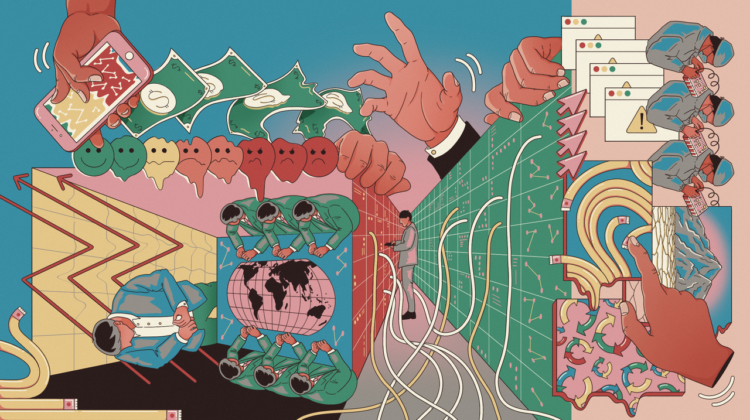
Image credit: Clarote & AI4Media / Better Images of AI / CC BY 4.0