


✍️ By Ismael Kherroubi Garcia.
Ismael is Founder & Co-lead of the Responsible Artificial Intelligence Network (RAIN), and Founder & CEO of Kairoi.
📌 Editor’s Note: This article is part of our Tech Futures series, a collaboration between the Montreal AI Ethics Institute (MAIEI) and the Responsible Artificial Intelligence Network (RAIN). The series challenges mainstream AI narratives, proposing that rigorous research and science are better sources of information about AI than industry leaders. This third installment of Tech Futures describes the threat of low-quality, AI-generated code being contributed at scale to the world’s open source digital infrastructure.
Generative AI tools are allowing people to make low-quality contributions to open source resources whose maintainers are already pretty stretched, and often volunteers. Before delving into what this means, consider an analogy.
Cats famously sit on laptops when you’re at work; they might make it impossible for you to type, or even push a few random keys themselves. Driven by curiosity, they might get up close and swipe at anything intricate that you’re working on, especially if there’s string involved. Finally, go under a sink to do some maintenance and the cat might just pop itself in the seemingly new space it had never before seen.
“Vibe contributing” to open source repositories is as helpful as a cat folding the laundry. Vibe contributing consists of mostly first-time contributors who don’t know what they’re contributing but want to be a part of whatever they’re attempting to contribute to. Generative AI tools are being used to vibe-code one’s way into an open source project. But these contributions, like all others, are subject to repositories’ quality assurance processes led by “maintainers.” For maintainers, reviewing low-quality code is especially burdensome when produced at scale. As one report finds, “AI accelerates output, but it also amplifies certain categories of mistakes,” with AI-generated code involving 1.7 times the errors of human-generated code.
But this is only one part of a much more complex picture. For starters, maintainers are often not paid for their work. In other words, vibe contributors are adding to the workload of volunteers. And maintainers are critical, as being stretched and underresourced can lead to lower quality of peer-review for potential contributions, and bugs being missed or not prioritized. What’s more, open source resources are already under great pressure from companies that want better services, governments imposing regulations, and systems that must adhere to high standards. The diversity of sources of pressure points to the critical nature of what open source code ultimately is: the world’s digital infrastructure.
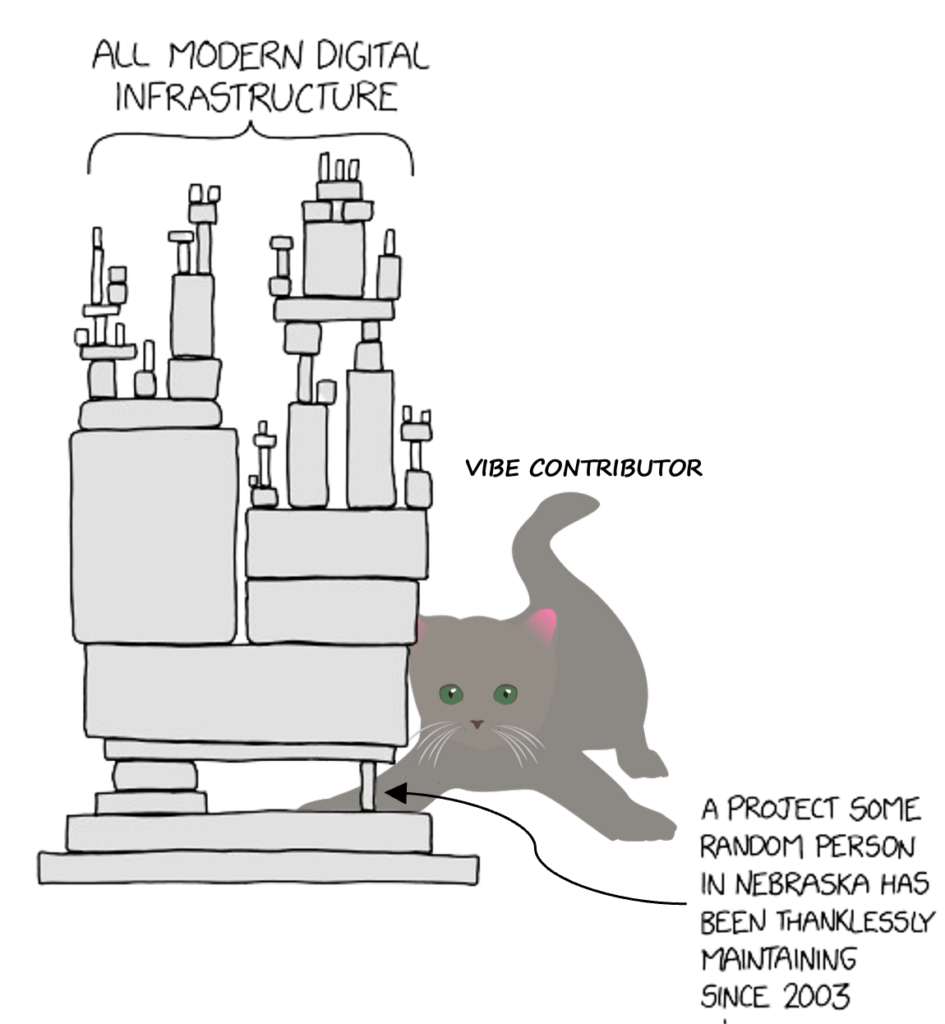
Caption: © 2026 Responsible Artificial Intelligence Network (RAIN) and Ismael Kherroubi Garcia, CC BY 4.0, adapted from xkcd.com (Dependency) and Ricinator on Pixabay
Towards Robust Digital Infrastructure
Open source projects can include everything from entire operating systems (e.g.: Linux) to messaging applications (e.g.: Signal) and field-specific software (e.g.: R for statistics and data visualization). Their variety and openness means that many can adapt and adopt their code –provided they respect any licensing requirements– including private and public sector organizations, and indeed other open source initiatives. The result is a complex interweaving of tools, dependencies and licences that seeps through into many of the closed-source software we are exposed to in our day-to-day, whether we know it or not.
Given the potential that comes with succeeding in the competitive computer science job market, showing public contributions to impactful open-source projects can be a differentiating factor. Unfortunately, there is an undeniably steep learning curve to making a valuable contribution. Even if we assume a contributor writes high-quality code, it will take time and research to ensure it meets the standards of the initiative to which they want to contribute. And then there is the need to understand relevant dependencies, and to collaborate with maintainers and other contributors to test assumptions and polish ideas. All in all, it takes hard work to make valuable changes to the world’s digital infrastructure.
Getting a job in what seems to be a lucrative field is not the only incentive for low-quality contributions; there is also the overemphasis of innovation over maintenance. Indeed, innovation is what maintainers are usually paid for – not the mundane tasks related to keeping digital infrastructure afloat. In this regard, the push for innovation and productivity that dominate AI narratives lend themselves seamlessly to the interests of funders in the open source ecosystem.
Until 2014, Meta (then Facebook) followed the motto “move fast and break things.” To this date, “move fast and break things” describes the spirit of many developments in data science and AI; indeed, the very essence of Silicon Valley. The desire for speed over care, and quantity over quality might be seen as overlapping with the incentive structures of the open source ecosystem, where innovation is valued above maintenance. With this, open source contributions have become ripe for the injection of AI-generated content.
However, Big Tech ideals are contrary to what open source stands for. Overwhelming maintainers with low-quality code is indicative of the tension between open source and Big Tech. Another source of tension is Big Tech co-opting “open source” when not meeting the high standards expected by maintainers and their wider communities. And this is without mentioning the long history and diversity of open science practices that are foundational to open source. Greater awareness of open source systems, practices and histories may dissuade poor code contributions. But much wider cultural and structural changes will be needed to dissuade vibe coders from undermining the world’s digital infrastructure.
Image credit: Gerhard Bögner from Pixabay