


✍️ By Kei Baritugo.
Kei is Director of Global Marketing Communications, Montreal AI Ethics Institute (MAIEI).
More than 6,500 leaders and innovators from over 40 countries gathered in Montreal for the ALL IN conference on September 24–25, 2025. Four themes emerged that signal where AI policy and adoption are headed.
1. Canada Accelerates Its National AI Strategy
Canada’s Minister of Artificial Intelligence and Digital Innovation, Evan Solomon, announced a new AI Strategy Task Force, which will operate on a 30-day timeline, with recommendations due by November 2025. The mandate spans research and talent, commercialization, infrastructure, trust and safety, education, and national security.
This accelerated approach reflects both opportunity and urgency. Canada has long been a leader in AI research, but maintaining this position requires coordinated action. The initiative also includes modernizing outdated privacy and data protection laws, a legislative gap that has constrained both innovation and public confidence.
“We are going to modernize Canada’s privacy and data laws. They are more than 25 years old,” said Minister Solomon at ALL IN. “Canada’s got to build a digital backbone that… keeps critical data under Canadian law.”
2. Trust and Safety: No Longer Optional

Steering AI development in a safer direction is urgently needed, given mounting evidence that frontier systems exhibit self-preserving and deceptive behaviours. AI deployment cannot be a “move fast and break things” exercise. Rather, governance, safety, and public trust must be built in by design.
In his fireside chat, Professor Yoshua Bengio brought a critical lens to the risks of scaling AI systems. “In order to deploy AI, the users, the companies that are going to use it, want some sufficient level of confidence that the AI is going to behave well; that in an interaction with the user, it’s not going to do something weird and dangerous—that is both a safety feature and a capability issue,” said Bengio.
As hype around AI grows, so do calls for guardrails. Minister Solomon’s Task Force mandate expressly includes ensuring safety and trust as well as data privacy and security. Across sessions, speakers emphasized that adoption must go hand in hand with governance: auditability, explainability, bias mitigation, and accountability frameworks will not be optional—they’ll likely become regulatory expectations.
3. AI Sovereignty Moves from Concept to Reality
Many presentations and panels advocated for AI sovereignty, ensuring that Canadian innovation, talent, and infrastructure remain anchored at home.
TELUS announced the opening of Canada’s first fully sovereign AI factory. The facility provides Canadian businesses, researchers, and innovators with cutting-edge AI capabilities, ensuring that data is stored securely within national borders.
“Businesses, researchers and governments should not have to rely on foreign-controlled systems to advance their AI ambitions,” said Darren Entwistle, President and CEO of TELUS. “Today, we are helping to achieve that: by delivering advanced compute power within data centres built, owned and operated by Canadians, TELUS is safeguarding our data, protecting our sovereignty and empowering our economy.”
This shift from concept to infrastructure positions Canada alongside other nations investing in sovereign AI capabilities. For regulated industries such as healthcare and finance, domestic computing resources significantly reduce a major barrier to adoption.
4. From Hype to Implementation: The Adoption Challenge
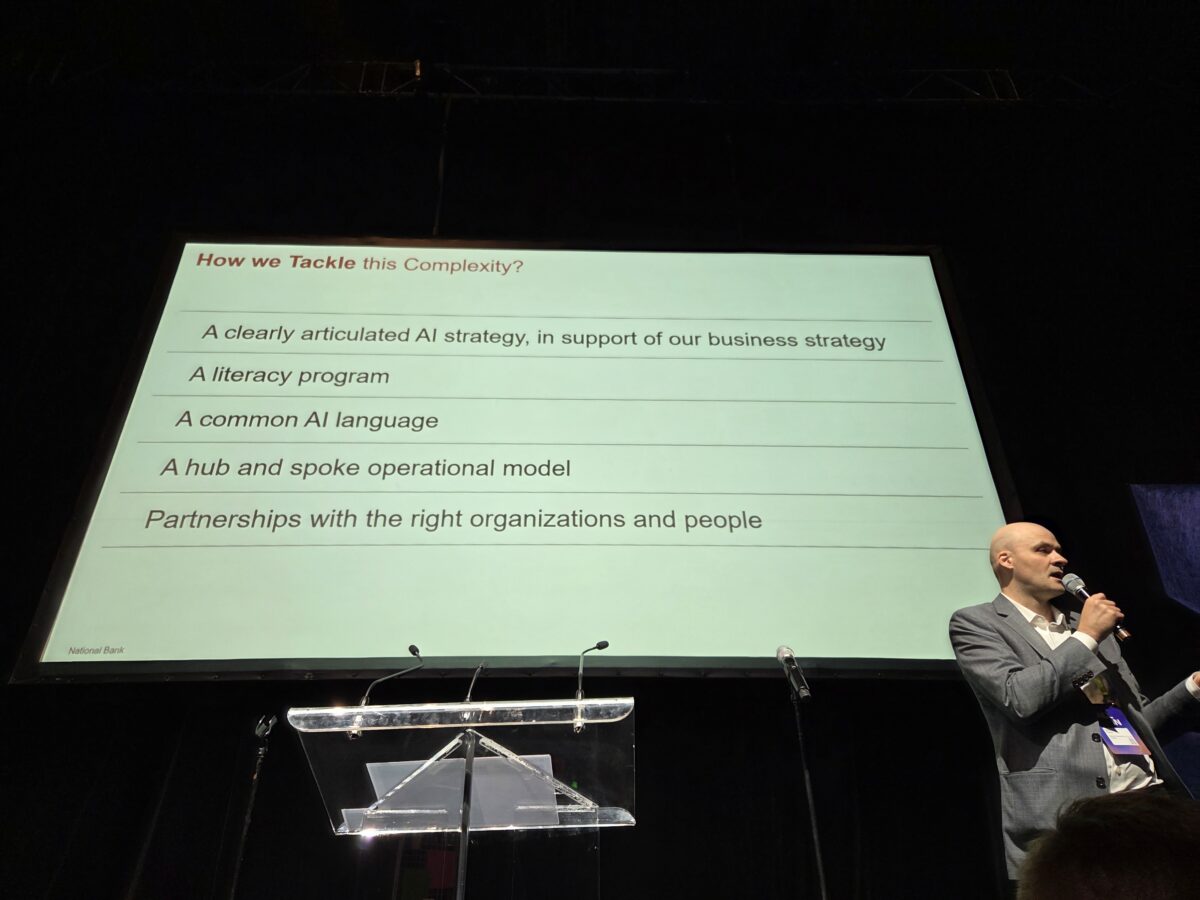
Several commentators emphasized that while foundational models and deep research still matter, the frontier now lies in bringing AI into everyday operations. The challenge? Adoption barriers are primarily organizational, including culture, processes, and regulations, rather than solely technical.
In the workshop Responsible AI: From Strategy to Practice, the National Bank of Canada shared its framework for sustainable AI adoption. According to Julien Crowe, senior director of AI products, practice, R&D and partnerships, the approach includes a clearly articulated strategy, a literacy program, a common AI language, a “hub and spoke” operational model, and strategic partnerships. The case illustrated how organizations can tackle complexity systematically rather than through ad hoc experimentation.
Despite significant interest in agentic AI, the technology has a long way to go. The panel, The Rise of Agentic AI: Opportunities and Challenges for Businesses, identified key obstacles, including a lack of standardized protocols, a shortage of mature products, high costs, and deployment difficulties at scale.
“If you ask the same prompt again, it [the answer] needs to be repeatable. By nature, non-deterministic systems are not going to say the same thing. So how do you build those guardrails? How do you make sure you put determinism in a fundamentally non-deterministic system? Because as everyone knows, hallucination is not a bug—it’s a feature when it comes to generative AI,” said panelist Gayathri Radhakrishnan, partner at Hitachi Partners.
From a workflow standpoint, the adoption of agentic AI may take a few more years to be fully suited for automating day-to-day manual tasks. Yet building the necessary skills remains critical. “My hope is rather than consuming somebody else’s AI … that we learn to adapt to this tech,” said Manav Gupta, VP of technical sales and chief technology officer at IBM Canada. “Those that don’t use this tech will be replaced by those who do.”
The tension is clear: organizations must move quickly enough to remain competitive while moving carefully enough to build proper foundations.
Looking Ahead
The 2025 ALL IN conference revealed an AI community in transition. Excitement now coexists with a greater sense of sobriety about risks and responsibilities. The shift from “What can AI do?” to “How do we ensure AI serves societal interests?” reflects a maturing ecosystem.
Key takeaways for organizations:
- Invest in governance early—it’s a competitive advantage, not just compliance
- Build organizational capacity beyond technical infrastructure
- Consider where your data lives and who controls your infrastructure
- Maintain realistic expectations about emerging capabilities
As Canada’s AI Strategy Task Force approaches its November deadline, the recommendations will provide insight into how one leading AI nation proposes to balance innovation with safety, speed with deliberation, and global collaboration with national interests.
Top image photo credit: @ISED_CA on X (Sep 26, 2025)