

✍️ By Ismael Kherroubi Garcia.
Ismael is Founder & Co-lead of the Responsible Artificial Intelligence Network (RAIN), and Founder & CEO of Kairoi.
📌 Editor’s Note: This article is part of our Tech Futures series, a collaboration between the Montreal AI Ethics Institute (MAIEI) and the Responsible Artificial Intelligence Network (RAIN). The series challenges mainstream AI narratives, proposing that rigorous research and science are better sources of information about AI than industry leaders. This second instalment of Tech Futures by RAIN celebrates the great potential of the UN’s Independent International Scientific Panel on AI, and the diversity of its membership.
“We need shared understandings to build effective guardrails, unlock innovation for the common good, and foster cooperation. The Panel will help the world separate fact from fakes, and science from slop.”
This was part of the announcement of 40 nominations for the Independent International Scientific Panel on AI by the UN Secretary-General António Guterres on 4th February. And that separation between “fact” and “fakes,” “science” and “slop” is exactly what this segment is all about.
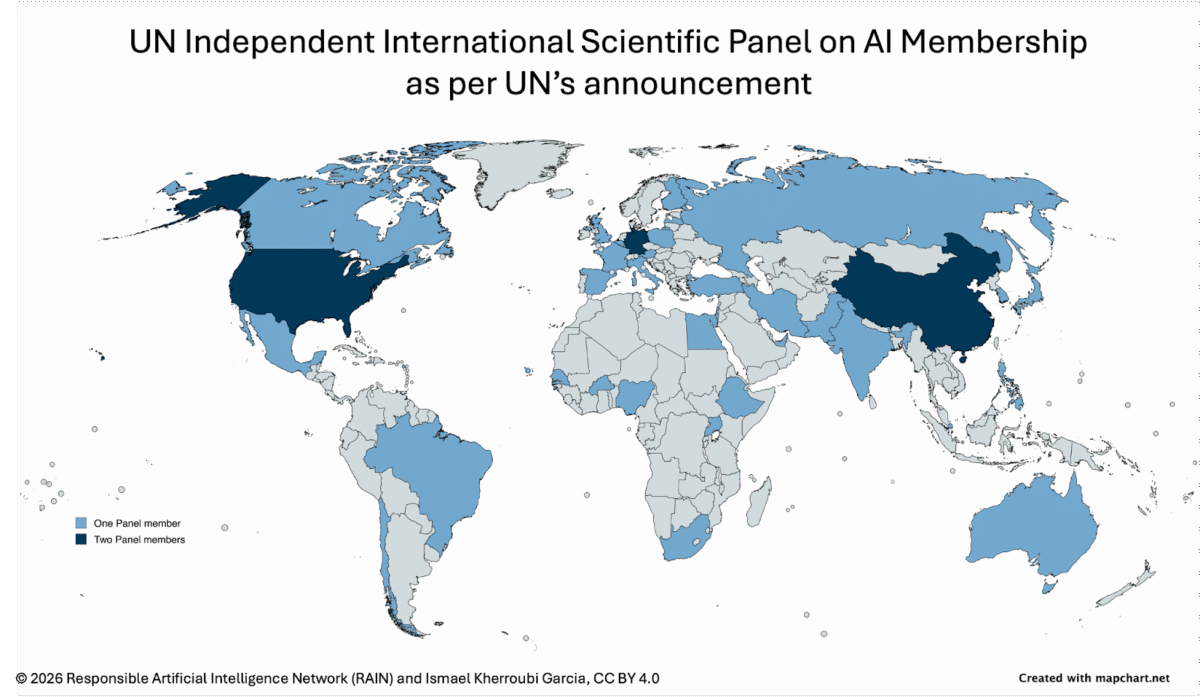
The nominees to the Panel were officially appointed on 12th February, and Guterres rightly celebrates the group’s diversity, with 19 women and 21 men from a total of 37 countries, with China, Germany and the US having two representatives each, rather than one. Although there are certain caveats to these numbers, there is great value to the diversity when we scratch the surface.
The Caveat
Though balanced in gender, the Panel is more representative of the Global North than the global majority. Following publicly available data about the Panel members, over half of them are based in Europe and North America. Indeed, nine are based in the US alone, and four in the UK. By this account, Germany turns out to only have one voice on the Panel whilst Austria and Canada go up from one to two. Kenya, Luxembourg and Switzerland also gain representatives when counting this way. These increases mostly result from shifts from the African continent, which has eight representatives by the UN’s count, but only three when considering where Panel members are based.
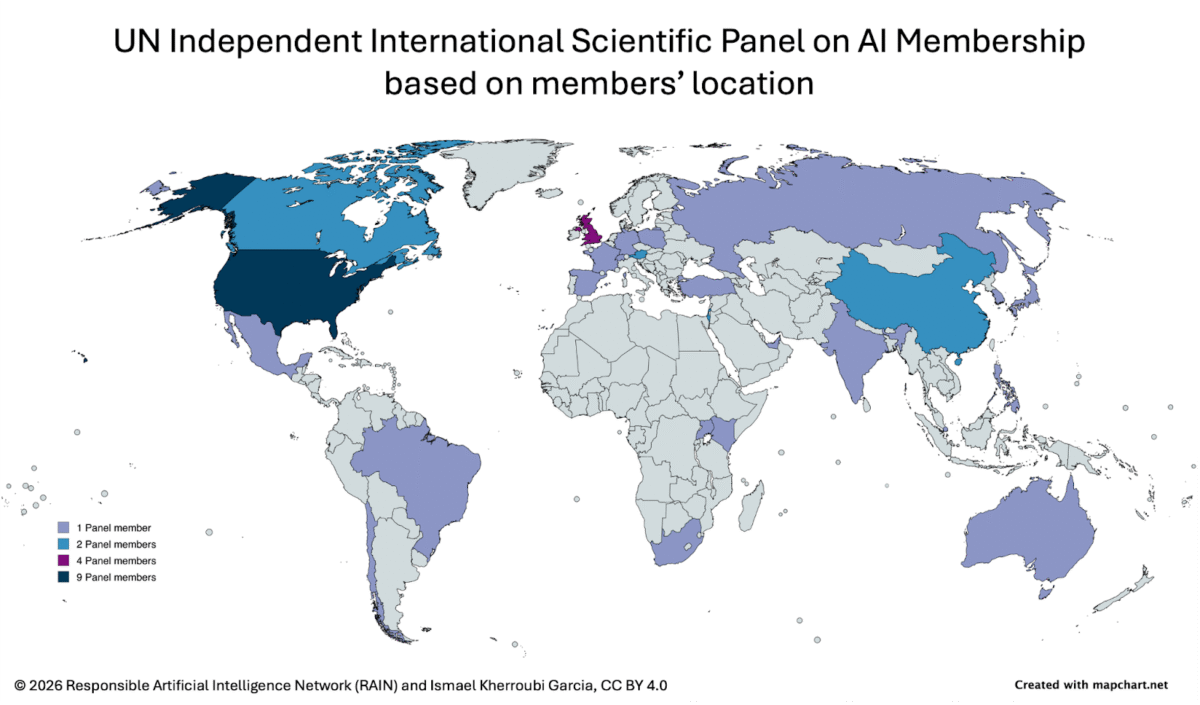
The comparison of where Panel members are from –what the UN announced– rather than where they are based illustrates a common theme in the recent history of technological advancements: the Global North has a great deal of power as to what technologies proliferate around the world. This is problematic when we consider that technology is not neutral; that technologies follow the logics of their creators, warts and all. Conversely, the world is far from homogeneous. Societies, regions and the people making them up are messy, diverse, and beautiful for it. If AI technologies impose what a small group of the most wealthy people on Earth value on the entirety of the planet, tensions will be inevitable.
The value of diversity
“Human life [is] like an enormous, ill-lit aquarium which we never see fully from above, but only through various small windows unevenly distributed around it. Scientific windows –like historical ones– are just one important set among these. Fish and other strange creatures constantly swim away from particular windows… reappearing where different lighting can make them hard to recognise. Long experience, along with constant dashing around between windows, does give us a good deal of skill in tracking them. But if we refuse to put together the data from different widows, then we can be in real trouble.” – Mary Midgley in Science and Poetry
The shift in the landscape of the Scientific Panel according to how you study its membership reflects some of the phenomenon that is Africa’s “brain drain” or “decapitalisation.” But the shift is not a bad thing if we consider the vast wealth of experience that comes with moving from one country to another. Panel members who are no longer based where they are from do not automatically shed the aspects of their identities that make them Senegalese, Iranian, German, Nigerian, Finnish and so on. Our identities are far more complex than where we are based and where we are from. And the science we do is all the better for it.
The scientific perspectives on AI in the Panel are not only richer for the gender balance and cultural diversity but also for its multidisciplinarity. Although there is a clear bias towards computer science and engineering, there is some diversity Panel expertise; physics has two representatives, whilst philosophy, environmental sciences, psychology, English, law and medicine each have one.
Concluding
Extending Midgley’s analysis, all subjects of scientific inquiry are like enormous, ill-lit aquariums which we never see fully from above, but only through various small windows unevenly distributed around them. It is only by looking through those different windows with different pairs of eyes that we might catch a glimpse of what we’re actually studying. The Panel will hopefully produce key insights that draw on the diversity of perspectives available. We are excited to follow how the Independent International Scientific Panel on AI advances, and to find an ally in the UN in the effort to “separate fact from fakes, and science from slop.”
Photo credit: Vibrant coral reef ecosystem illustration by brgfx on Freepik