
✍️By Alexandria Workman
Alexandria is an Undergraduate Student in Political Science and minoring in Business at Indiana University, as well as an Undergraduate Affiliate at the Governance and Responsible AI Lab (GRAIL), Purdue University.
📌 Editor’s Note: This article is part of our AI Policy Corner series, a collaboration between the Montreal AI Ethics Institute (MAIEI) and the Governance and Responsible AI Lab (GRAIL) at Purdue University. The series provides concise insights into critical AI policy developments from the local to international levels, helping our readers stay informed about the evolving landscape of AI governance. This article will explore how U.S. AI policies aimed at restricting China may protect national security, but they risk weakening global influence by pushing other countries toward China’s more cooperative and accessible approach to AI development.
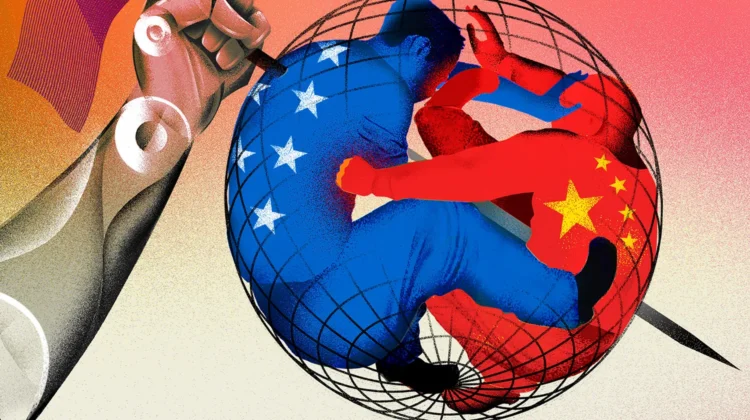
Major powers like the United States and China are often portrayed as being in a race for technological dominance on the global stage. This narrative appears frequently in political discourse and media coverage. However, the U.S. and China frame this competition differently, shaping not only their domestic policies but also their relationships with the rest of the world.
When looking at current U.S. federal legislation, there are several bills that focus on monitoring and restricting China’s technological development. For example, measures such as the Fair Trade with China Enforcement Act aim to strengthen oversight of trade practices and ensure that China is complying with international rules, particularly in areas related to technology and intellectual property. Similarly, the Bureau of Industry and Security Information Technology Modernization Act focuses on improving the government’s ability to track and regulate the export of sensitive technologies, including those tied to artificial intelligence.
The U.S. has taken a more restrictive approach, at least in part due to concerns over intellectual property theft and national security. When observing the U.S. and China, however, a contrasting approach emerges. The U.S. is primarily focused on limiting a rival, while China presents itself as expanding opportunities for others. As the U.S. leads in AI and seeks to slow China’s progress, China presents itself as a cooperative partner to gain a strategic advantage.
China’s Global AI Governance Initiative presents AI development as a collaborative effort focused on fairness, shared growth, and broader access. This messaging plays a strategic purpose for China by positioning itself as a supportive global partner. This is an effective strategy for China because, from an outsider’s point of view, it sounds diplomatic and cooperative.
While the U.S. strives to maintain AI dominance, the American policies can create the perception among other countries that access to advanced AI can include political coercion. This perception is reinforced by U.S. export controls that support chip manufacturing, aimed to slow China’s AI development and maintain a technological advantage. With AI development relying on chip manufacturing and exports, these policies limit both industries and allies, such as those found in the Netherlands, Taiwan, and Japan. The result is that allies could back away from America due to the constant changing political winds.
China, on the other hand, is framing their policy in a more attractive way for other countries, especially developing countries, seeking rapid technological growth. For example, they proposed a resolution during the 78th United Nations General Assembly in 2024 to “strengthen international AI capabilities” within countries around the world. We can also see China providing AI capacity-building workshops that are being held with international participants, especially in Central Asia and Arab countries, and Southeast Asia.
The contrasting approaches create a situation where countries will need to choose which global power they will want to get their AI technology from. It is also true that countries are trying to prevent being permanently dependent on foreign AI systems because it is domestically safer to use AI systems that are locally developed and managed. AI can impact a country’s language, culture, politics, education, surveillance, and military power. The U.S. government approach risks accelerating other countries’ interest in sovereign AI development and implementations, instead of investing in and adopting the American AI stack.
If the United States does not adjust its strategy in the near future, the increasing coercion and uncertainty may lead to more tension between the U.S. and potential AI partners. This would create more risk since countries would be more likely to not adopt the American AI stack and instead buy into, or be amenable to the Chinese stack. Although U.S. policy is designed to preserve U.S. advantages over China and other countries, these policies may weaken U.S. influence if other countries see American AI as politically coercive to their own goals. As a result, American messaging may cause them to look elsewhere for AI support and technology.
Further Readings:
- Opinion: The U.S. needs to go on AI offense – Washington Post
- US to safety test new AI models from Google, Microsoft, xAI – BBC
- Opinion: The US can’t just invent a future with AI — it must deploy it. – The Hill
- America’s AI Action Plan – White House
Image link: https://foreignpolicy.com/2023/06/19/us-china-ai-race-regulation-artificial-intelligence/