
✍️ Column by Venus Krier, a freelance illustrator and animator.
Overview: In this intricate tapestry of artistry and technology, I chart my transformative journey from the tactile world of analog art to the boundless realms of digital creation and AI integration. Embracing the unpredictable allure of wet-on-wet ink techniques, I harmonize them with the precision of digital tools, crafting a visual language that parallels my evolving understanding of AI’s role in art. This narrative isn’t just about adapting to new tools; it’s a deeper exploration of how AI, while streamlining certain aspects of creativity, also challenges the traditional notions of artistic growth, learning, and the very essence of time in the creative process.
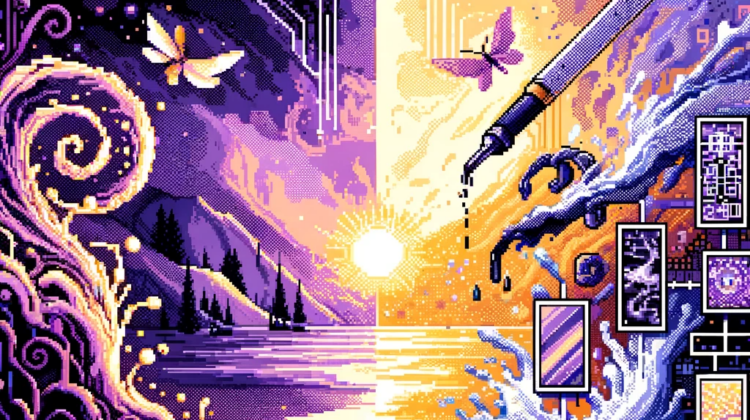
After a recent career change, I redirected myself back to art. Since then, I’ve freelanced, specializing in animation, illustrations, and graphic design. This journey has been a transformative experience, as I’ve learned to appreciate and employ a combination of analog and digital techniques in my work. Often, in my animations, I paint with analog techniques. One that I particularly like is wet on wet ink, giving its unpredictable and less controllable effect. I then scanned them and used digital software to draw very crisp lines over them. Both techniques combined create visually interesting outcomes; in a way, this lens nicely illustrates how I understand the usefulness of AI.
As I was still transitioning away from my previous career, I’ve had to learn and adapt to a variety of digital tools over the years, such as those from the Adobe suite; this was a bit of a challenge, as for the previous decade I had always focused on analog media such as paintings or collages. I initially hesitated to use software, but I quickly realized the possibilities they offered to expand my creative horizons. I’ve since tried to adopt a similar approach to AI: I don’t see it as a way of automating my work away but as enabling and allowing a wide variety of tools to help me refine my work, find inspiration, learn how to use new software or troubleshoot technical problems in my work.
What truly makes my job fascinating are the constant challenges and the continuous learning it entails. Working through the creative process, I discover unexpected paths and problems to solve, acquiring additional knowledge along the way; errors sometimes lead to serendipity. This journey culminates in the immense satisfaction of creating and completing pieces. Often, when I initiate a project with a specific idea in mind, the final result becomes far more intriguing and diverse as it evolves through the many dilemmas I encounter along the way. In fact, the result often differs from the original idea; in the creation process, I also ask myself, “What knowledge or skills am I lacking? How could I achieve this another way? What if I tried this particular approach?” These challenges force me to learn additional skills and programs, which, in return, enable me to create more and more diverse projects.
AI can play a role in answering these questions, but overreliance sometimes leads to standardized outcomes – there is clearly a skill to be developed in how to use these tools and when to use them. While AI models can streamline time-consuming tasks and afford more time for exploration and creative experimentation – immediate rectifications and solutions may come at the cost of true reflection. Perhaps we lose some value by no longer benefitting from the process of trial and error.
While AI and Art are often associated with MidJourney DALL-E, etc, other AI tools, such as ChatGPT, have proven highly useful too. As a freelancer, they allow me more time to focus on my work rather than administrative tasks: for instance, the creation of contracts, refining grant applications, reducing reliance on accountants or marketing, and so on. This may seem obvious, but such tasks sometimes take up much time. People are sometimes reluctant to try new technologies, but I think it’s important for artists to see how they can use them to their advantage.
Having said that, I can’t help but harbor concerns about its potential impact on jobs and the ethical questions surrounding its use in the long run. If my work can ultimately be replicated on end by a cheaper digital replica, what incentives do I have to make this my career? Ultimately, my apprehension stems from the concern that AI compromises the essence of time. Time is a crucial element in the artistic process. Where is the pleasure or enrichment when something can be created in a matter of seconds? Even as an artist, one becomes more proficient and efficient with technical and motor skills over time, enabling greater creativity. However, the process of learning, practice, and the passage of time fosters this growth. I fear that the expectation to work at an accelerated pace may diminish the intrinsic value of artistry. AI’s rapid ability to replicate will deprive individuals of the time needed to learn and make mistakes and push impatient clients to rely solely on AI tools. This might not necessarily be the case; in this fast-paced environment, perhaps people will seek out more “hand-made” art. Many want to express their individuality by having unique pieces, much like the current trend in handcrafted furniture and clothing, where handmade often resonate with unique and quality products.
Lastly, issues related to copyright and the appropriation of others’ work without consent remain unresolved. There is hope that some initiatives, like watermarking and ‘opt-outs,’ will be implemented in the art industry. There are already many artistic platforms addressing this issue – see, for example, the resources listed on Roxana Lapa’s website, a digital artist and designer who has written about The Impact of AI Art on the Creative Industry.
To conclude, the only way forward is not to resist this technology but to help shape it to fit our needs. This can take the form of novel tools, better regulations, and the enforcement of copyright laws. Artists should not shun AI completely. Adapting to new technologies is difficult, but the rewards can be enormous if done well.