

• Skip to main content
  • Skip to secondary menu
  • Skip to primary sidebar
  • Skip to footer
Montreal AI Ethics Institute

Montreal AI Ethics Institute

Democratizing AI ethics literacy

  • Articles
    • Public Policy
    • Privacy & Security
    • Human Rights
      • Ethics
      • JEDI (Justice, Equity, Diversity, Inclusion
    • Climate
    • Design
      • Emerging Technology
    • Application & Adoption
      • Health
      • Education
      • Government
        • Military
        • Public Works
      • Labour
    • Arts & Culture
      • Film & TV
      • Music
      • Pop Culture
      • Digital Art
  • Columns
    • AI Policy Corner
    • Recess
    • Tech Futures
  • The AI Ethics Brief
  • AI Literacy
    • Research Summaries
    • AI Ethics Living Dictionary
    • Learning Community
  • The State of AI Ethics Report
    • Volume 7 (November 2025)
    • Volume 6 (February 2022)
    • Volume 5 (July 2021)
    • Volume 4 (April 2021)
    • Volume 3 (Jan 2021)
    • Volume 2 (Oct 2020)
    • Volume 1 (June 2020)
  • About
    • Our Contributions Policy
    • Our Open Access Policy
    • Contact
    • Donate

The Ethical AI Startup Ecosystem 01: An Overview of Ethical AI Startups

June 5, 2022

šŸ”¬ Original article by Abhinav Raghunathan, the creator of EAIDB who publishes content related to ethical ML / AI from both theoretical and practical perspectives.


This article is a part of our Ethical AI Startups series that focuses on the landscape of companies attempting to solve various aspects of building ethical, safe, and inclusive AI systems.


There’s no questioning the ubiquity of artificial intelligence (AI). There’s no argument that can be made that AI is not at the core of Western society, part of the fabric of our everyday lives.

Over the past three decades, a greater emphasis has been placed on growth, on scale, on the positive potential of AI. It is now used constantly in every context as a solution to every problem. But times have changed. Only recently have thought leaders in the space transitioned the thinking away from unparalleled growth (AI has grown enough) and towards controlling AI riskā€Šā€”ā€Šthe negative potential for AI to perpetuate bias, generate disinformation, and much more. When AI fails, it fails explosively.

Solutions came in droves as soon as it became clear to investors, governments, and business owners that AI risk can be dangerous and costly and that consumer trust (which directly translates to profit) is increasingly hard-earned in a world with so many cases of AI run rampant. Many ethical AI vendors are in their infancyā€Šā€”ā€Šstartups attempting to combat the wide world of irresponsible AI. The ethical AI space itself is a relatively small blip on the funding worlds’ radar: underrepresented, underfunded, and underrated.

This column is a comprehensive guide to the five different categories of ā€œEthical AIā€ startups and the dynamics between them. We will analyze trends, make predictions, and identify the strengths and weaknesses of each category of this fascinating and critical startup ecosystem.

The Ethical AI Database (EAIDB)

Everyone throughout the company lifecycle (from founders to investors to end users) are gradually becoming more aware and more receptive to transforming AI into a more ethical version of itself. To accelerate the conversation, the industry must be made more transparentā€Šā€”ā€Šthe companies recognized, the founders and investors alerted, the policymakers aware. This is where EAIDB comes into play.

EAIDB is a live database of startups that either provide tools to make existing AI systems ethical or build products that remediate elements of bias, unfairness, or ā€œunethicalnessā€ in society. EAIDB also publishes quarterly market maps / reports and spotlights constituent companies.
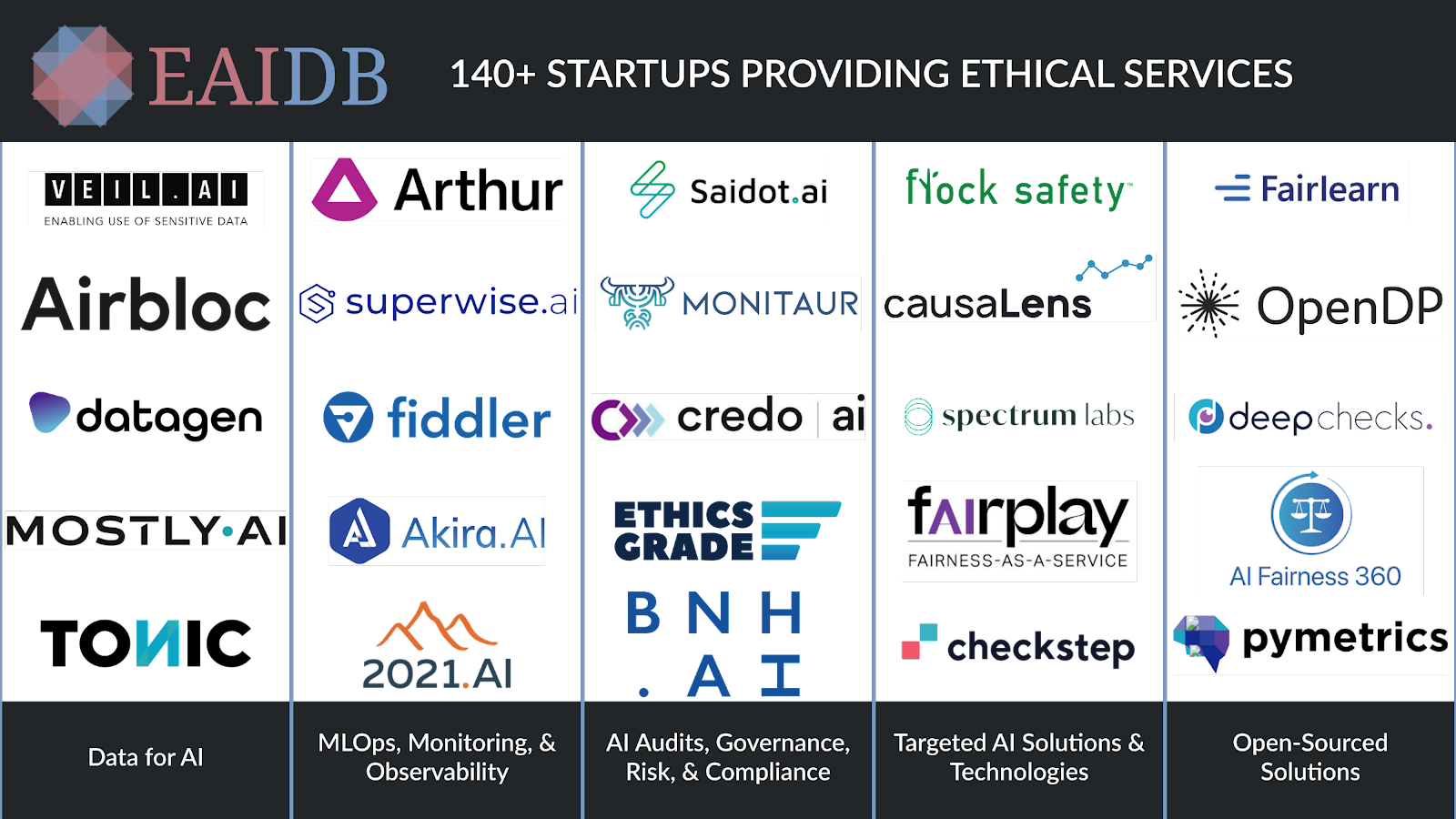
Preview of the EAIDB Market Map for Q1 2022.

Startups that dedicate their services and products to enabling responsible technology are broken into five categories: 

  1. Data for AI
  2. ModelOps, Monitoring, & Observability
  3. AI Audits, Governance, Risk, & Compliance
  4. Targeted AI Solutions & Technologies
  5. Open-Sourced Solutions

In subsequent pieces, each of these five categories will be explored in detail.

Growth + Trends

The data EAIDB has collected on its 140+ ethical AI startups shows that both investor and founder interest is growing. As of 2016, only 28 of EAIDB’s constituents were active. In 2022, we recorded 153 active companies (a total growth of about 446% and a CAGR of about 32.7%). Clearly, this space is profitable and motivation to make technology responsible exists.
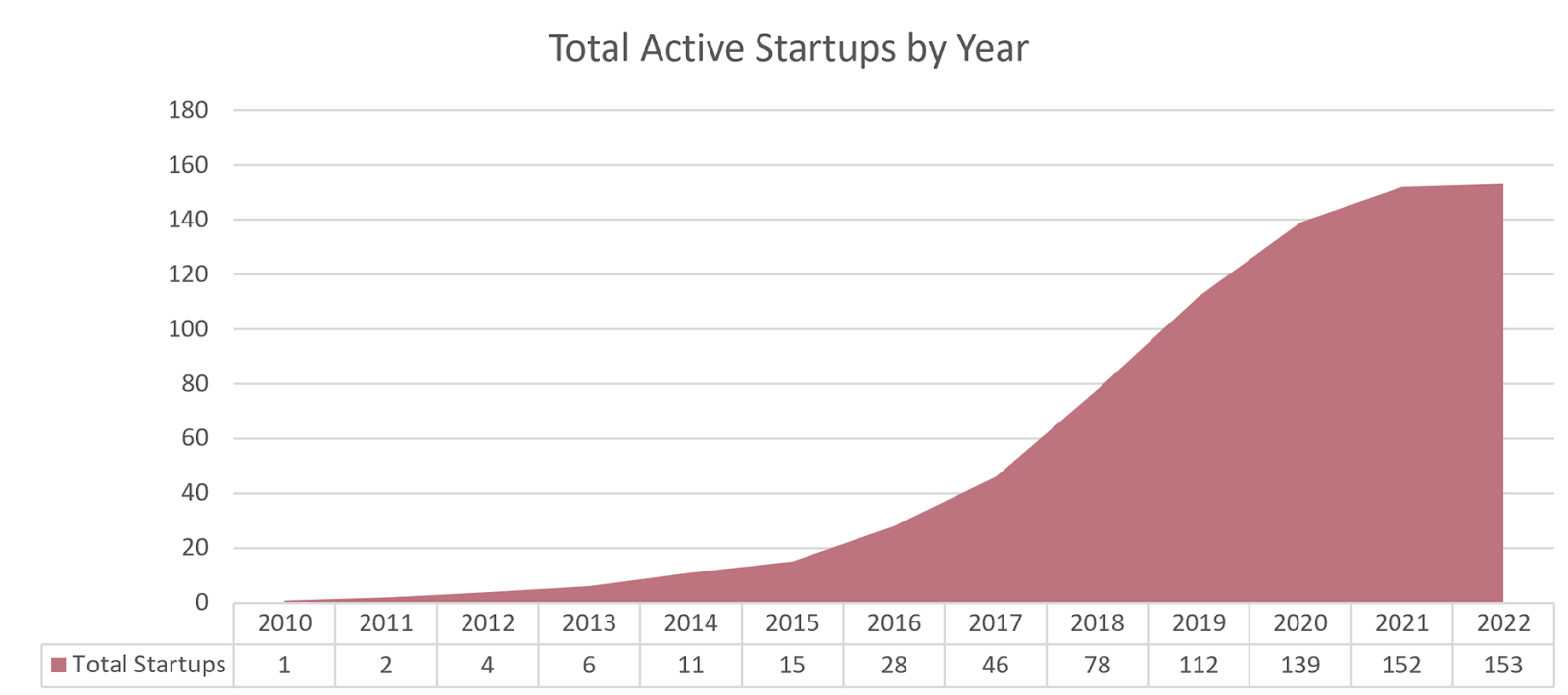
Total active Ethical AI startups by year.

A category-wise breakdown reveals that, in recent years, the buzz has been mostly around data-related operations (ā€œData for AIā€) and GRC (ā€œAI Audits, Governance, Risk, & Compliance).

Growth in categories of EAIDB by founding year.

Most thought leaders in this space agree that motivation is only increasingā€Šā€”ā€Šwhether through fear or through willingness. Policy changes made by those like the New Zealand and Scottish governments, the State of New York and California, and others will surely drive a stronger business need to mitigate AI risk. There is sound logic behind the claim that the ā€œethical AIā€ sector might approximate the growth curves of the privacy boom of the mid-2010s or the cybersecurity boom in the late-2000s. Only time will tell.

The next issue of Ethical AI Startups will cover the first of our categories: Data for AI.

To learn more about EAIDB, visit the dedicated website at https://eaidb.org.

Want quick summaries of the latest research & reporting in AI ethics delivered to your inbox? Subscribe to the AI Ethics Brief. We publish bi-weekly.

Primary Sidebar

šŸ” SEARCH

Spotlight

Close-up of a cat sleeping on a computer keyboard

Tech Futures: The threat of AI-generated code to the world’s digital infrastructure

The undying sun hangs in the sky, as people gather around signal towers, working through their digital devices.

Dreams and Realities in Modi’s AI Impact Summit

Illustration of a coral reef ecosystem

Tech Futures: Diversity of Thought and Experience: The UN’s Scientific Panel on AI

This image shows a large white, traditional, old building. The top half of the building represents the humanities (which is symbolised by the embedded text from classic literature which is faintly shown ontop the building). The bottom section of the building is embossed with mathematical formulas to represent the sciences. The middle layer of the image is heavily pixelated. On the steps at the front of the building there is a group of scholars, wearing formal suits and tie attire, who are standing around at the enternace talking and some of them are sitting on the steps. There are two stone, statute-like hands that are stretching the building apart from the left side. In the forefront of the image, there are 8 students - which can only be seen from the back. Their graduation gowns have bright blue hoods and they all look as though they are walking towards the old building which is in the background at a distance. There are a mix of students in the foreground.

Tech Futures: Co-opting Research and Education

Agentic AI systems and algorithmic accountability: a new era of e-commerce

related posts

  • Sharing Space in Conversational AI

    Sharing Space in Conversational AI

  • AI Ethics and Ordoliberalism 2.0: Towards A ā€˜Digital Bill of Rights

    AI Ethics and Ordoliberalism 2.0: Towards A ā€˜Digital Bill of Rights

  • Lanfrica: A Participatory Approach to Documenting Machine Translation Research on African Languages ...

    Lanfrica: A Participatory Approach to Documenting Machine Translation Research on African Languages ...

  • Towards A Unified Utilitarian Ethics Framework for Healthcare Artificial Intelligence

    Towards A Unified Utilitarian Ethics Framework for Healthcare Artificial Intelligence

  • Supporting Human-LLM collaboration in Auditing LLMs with LLMs

    Supporting Human-LLM collaboration in Auditing LLMs with LLMs

  • U.S.-EU Trade and Technology Council Inaugural Joint Statement – A look into what’s in store for AI?

    U.S.-EU Trade and Technology Council Inaugural Joint Statement – A look into what’s in store for AI?

  • Corporate Governance of Artificial Intelligence in the Public Interest

    Corporate Governance of Artificial Intelligence in the Public Interest

  • Demystifying Local and Global Fairness Trade-offs in Federated Learning Using Partial Information De...

    Demystifying Local and Global Fairness Trade-offs in Federated Learning Using Partial Information De...

  • Fair Interpretable Representation Learning with Correction Vectors

    Fair Interpretable Representation Learning with Correction Vectors

  • Designing for Meaningful Human Control in Military Human-Machine Teams

    Designing for Meaningful Human Control in Military Human-Machine Teams

Partners

  • Ā 
    U.S. Artificial Intelligence Safety Institute Consortium (AISIC) at NIST

  • Partnership on AI

  • The LF AI & Data Foundation

  • The AI Alliance

Footer


Articles

Columns

AI Literacy

The State of AI Ethics Report


About Us


Founded in 2018, the Montreal AI Ethics Institute (MAIEI) is an international non-profit organization equipping citizens concerned about artificial intelligence and its impact on society to take action.

Contact

Donate


  • Ā© 2025 MONTREAL AI ETHICS INSTITUTE.
  • This work is licensed under a Creative Commons Attribution 4.0 International License.
  • Learn more about our open access policy here.
  • Creative Commons License

    Save hours of work and stay on top of Responsible AI research and reporting with our bi-weekly email newsletter.