

🔬 Research Summary by ✍️ Anastasia Siapka.
Dr Anastasia Siapka is an attorney-at-law as well as an AI law and ethics researcher affiliated with the KU Leuven Centre for IT & IP Law in Belgium.
[Original Paper by Anastasia Siapka]
📌 Editor’s Note: This Research Summary, originally written in April 2024, was part of the proceedings of the 2022 AAAI/ACM Conference on AI, Ethics, and Society (AIES’22) held on August 1–3, 2022, in Oxford, UK.
Overview: Despite numerous guidelines and codes of conduct about the ethical development and deployment of AI, neither academia nor practice has undertaken comparable efforts to explicitly and systematically evaluate the field of AI ethics itself. Such an evaluation would benefit from a feminist metaethics, which asks not only what ethics is but also what it should be like.
Introduction
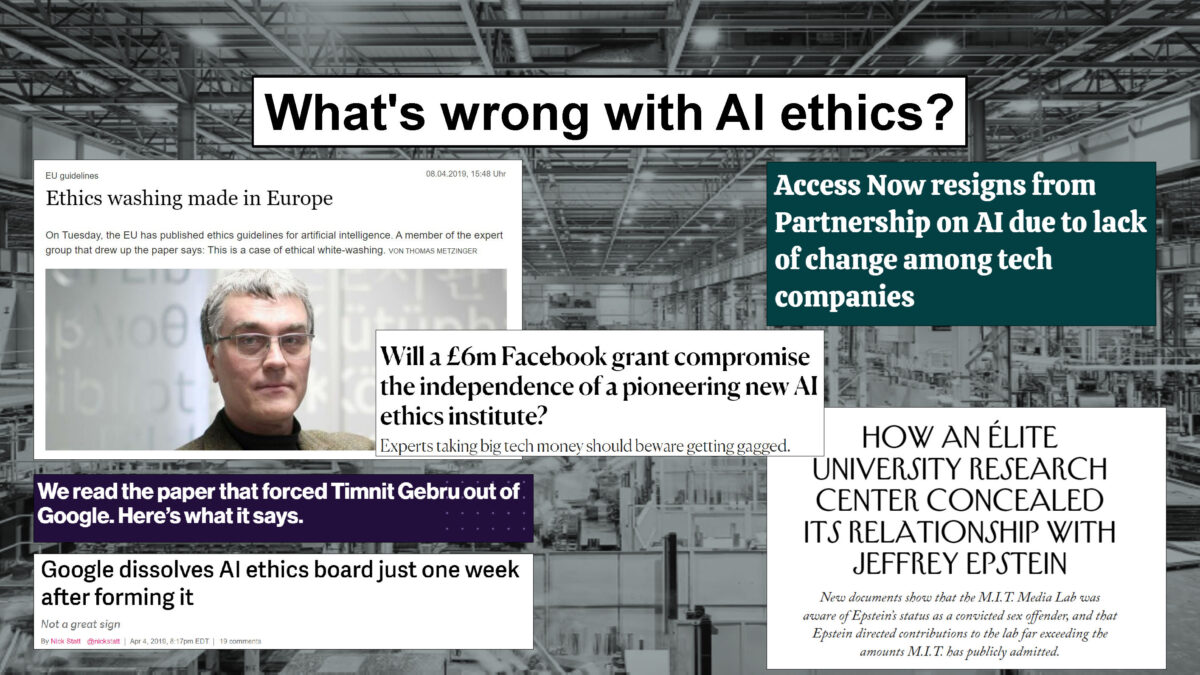
The widespread adoption of AI has led to the growth of AI ethics as a field of study. The legitimacy of the field, however, is challenged in light of recent problematic incidents. By way of illustration, the allegations of ethics-washing against the High-Level Expert Group on AI, the launch of a Facebook-funded academic centre for AI ethics, and the departure of high-profile AI ethicists from Google urgently suggest the need for critical self-reflection within the field.
In response to this need, I seek recourse to feminist metaethics. Traditional metaethics describes and explains morality and moral judgements: it is a second-order reflection about normative enquiry that is itself non-normative. Conversely, given its origins in a movement for political change, feminist philosophy is committed to being normative. It embraces a broader metaethics, interrogating how we are and how we should (or should not) be doing ethics.
Key Insights
Considering the context of AI, I suggest four lines of enquiry that a feminist metaethics would follow.
1. The continuity between theory and action in AI ethics:
Feminist metaethics does not assume that ethical theorising always deserves societal support. Accordingly, AI ethicists should reflect on whether AI is unique such that it warrants a distinct ethical sub-field (and thereby distinct funding or other support) or whether its ethics could instead be modelled on established sub-fields—say bioethics. They should further interrogate the alignment of such theorising with action on societal, individual, and technological levels by asking whether the principles and values of AI ethics should be mirrored in policymaking, their own personal conduct, and technology design practices.
2. The real-life effects of AI ethics:
Feminist metaethics acknowledges the practical and societal, rather than merely intellectual, import of ethics. Nonetheless, applying ethical theories to real-life cases might have unexpected or even harmful effects. A feminist metaethics of AI would thus detect, criticise, and seek to mitigate the potentially adverse effects of AI ethics discourse. Such effects include ethics-washing (using ethical language to give the appearance of ethical behaviour while justifying de-/self-regulation), ethics-shopping (picking and choosing from the ‘marketplace’ of ethical theories those that rationalise one’s behaviours), ethics as branding (instrumentalising ethics as a sales pitch to appease criticism and promote business uptake), and ethics-bashing (reducing the ethical discourse to instances of its misuse and fostering distrust towards it).
3. The role and profile of AI ethicists:
A feminist metaethics would explore the division of labour in AI ethics between theoretical and applied research as well as different disciplines. Feminist metaethics laments the separation between, on the one hand, theoretical ethicists who are detached from the implications of their academic theories and, on the other, applied ethicists who selectively apply the theories that best fit the practical goals at hand. Instead, AI ethics would benefit from combining theoretical insights with practical experience in AI. Moreover, philosophers, lawyers, computer scientists, business managers, and citizens all claim expertise in AI ethics. The roles, contributions, and interactions of these actors merit further clarification, as does the broader question of what constitutes ethical expertise in the first place.
4. The topics and methods of AI ethics:
Feminist metaethics focuses on distinct topics, particularly those relevant to women. It would subsequently assess the impact of AI on individuals not in the abstract but in view of their gender and other intersectional identity markers, such as class, race, disability, and sexuality. More broadly, it makes visible power asymmetries that traditional metaethics abstracts away. In so doing, it employs distinct methods, rejecting ideal theory and pure objectivity and instead engaging with individuals’ lived experiences and contexts. This engagement could involve listening to and amplifying the testimonies of situated agents affected by AI, examining the normative implications of AI-related concepts and undertaking conceptual amelioration, and accounting for agents’ affective states and interpersonal dependencies.
Between the lines
This paper, bringing previously disparate concerns under the umbrella of a ‘feminist metaethics of AI,’ offers a first pass at systematising second-order reflection on AI ethics. Already at this preliminary stage, though, it aspires to encourage conversations about AI ethics that extend beyond the ivory tower into the real world.